
Introduction
Optimizing a training bot is crucial for achieving sales success in today’s competitive landscape. Understanding the nuances of audience needs and implementing diverse training strategies can significantly enhance customer engagement and conversion rates. However, navigating the complexities of effective bot training and performance monitoring presents a challenge.
What best practices can businesses employ to ensure these AI-driven tools not only meet but exceed expectations? By focusing on targeted strategies and leveraging data-driven insights, organizations can elevate their training bots to new heights, ultimately driving better results and fostering stronger customer relationships.
Identify Your Target Audience and Their Needs
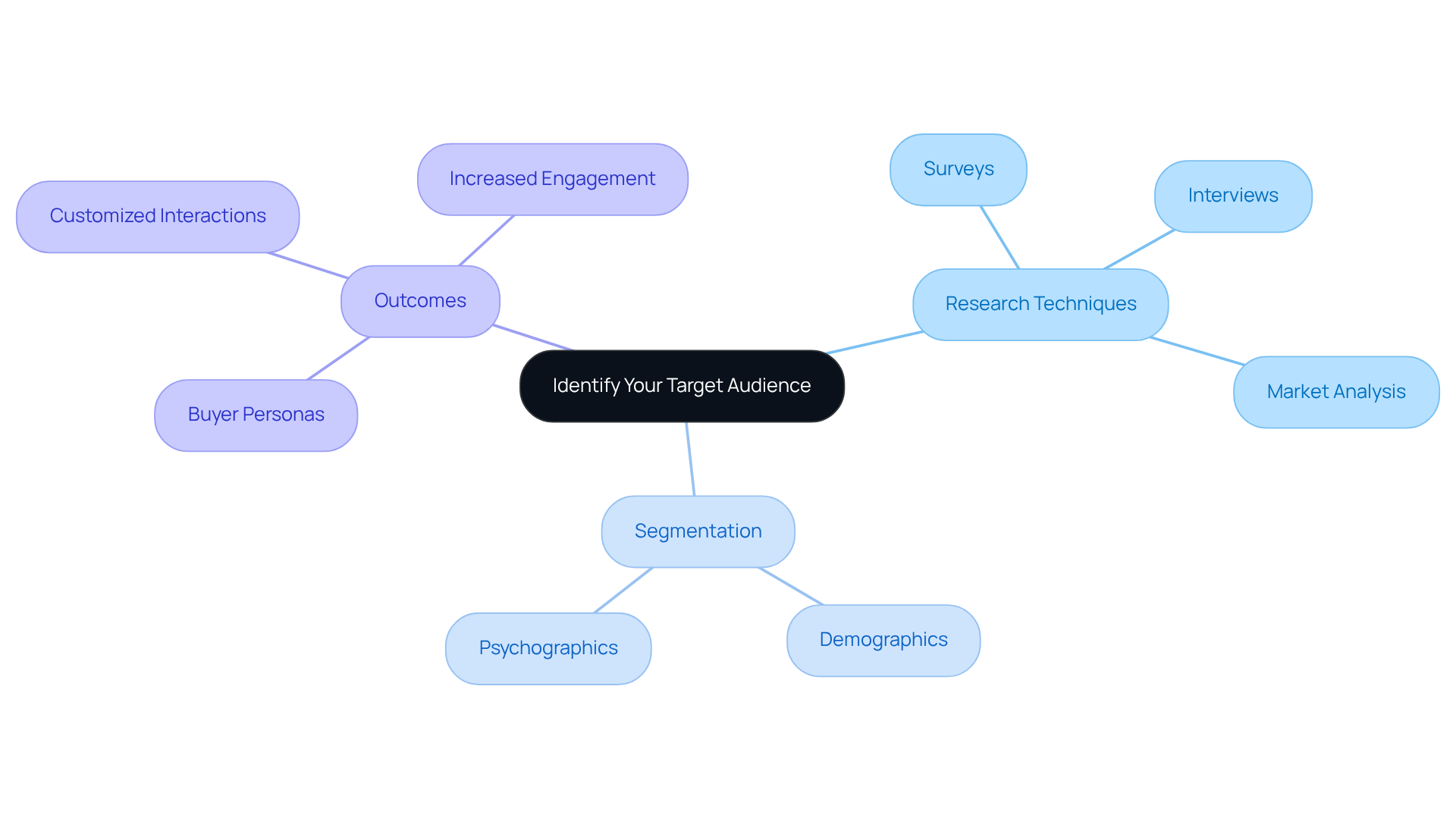
To effectively enhance your bot, start with thorough research to identify your target audience. Utilize techniques such as surveys, interviews, and market analysis to into their preferences, behaviors, and pain points. Segment your audience based on demographics - like age, income, and location - as well as psychographics, including interests and values. This method allows for the creation of detailed that inform the .
Understanding your audience's needs leads to customized interactions facilitated by the training bot that resonate, ultimately and increasing conversion rates. For instance, the GCS case study demonstrates how Intone's , developed with a clear grasp of their audience, achieved significantly higher engagement levels. The intelligent analytics and provided by Intone's AI solutions further underscore the critical role of in AI voice technology, particularly in and client engagement within the .
Implement Diverse Training Techniques for Optimal Responses
Employing a combination of is essential to maximize the effectiveness of your training bot. Start with , where the bot is trained on labeled datasets that accurately depict real user interactions. This foundational step ensures that the bot understands the nuances of .
Next, integrate to mimic a range of client situations. This allows the bot to acquire suitable reactions in various contexts, enhancing its adaptability. Additionally, implement , which enables the training bot to receive feedback on its performance and refine its responses over time. This multifaceted approach not only enhances the bot's accuracy but also significantly improves its ability to engage customers in a natural, conversational manner.
For instance, Intone's utilize these various development methods, including human-in-the-loop optimization. This technique enables based on feedback, leading to a that is 1.5 times greater than conventional sales techniques. By submitting your use cases, scripts, and development materials, you can further customize the AI agent, ensuring it aligns perfectly with your business objectives.
Moreover, with 24/7 AI agents, you can guarantee and engagement with your clients. This comprehensive strategy not only positions your bot for success but also drives meaningful interactions that can elevate your business.

Monitor and Optimize Bot Performance Regularly
To ensure your training bot remains effective, establishing a routine for is crucial. Start by utilizing to track essential metrics such as reaction time, client satisfaction scores, and . Regularly reviewing these metrics not only helps identify trends but also pinpoints areas for improvement. For instance, if the training bot's response time is lacking, optimizing its algorithms or expanding its could be beneficial.
Moreover, actively collecting is vital for understanding their experiences and expectations. This feedback loop is essential for making informed adjustments that enhance the performance of the training bot. Companies like Intone have successfully employed to consistently improve their , resulting in better engagement and increased .
Statistics reveal that can lead to a 30% reduction in customer service time and significantly . In fact, 73% of users believe AI can positively impact their experience. By prioritizing these analytics practices, businesses can optimize their for maximum effectiveness.

Conclusion
Optimizing a training bot is not just beneficial; it’s essential for driving sales success. It all starts with a deep understanding of your target audience. By conducting thorough research to identify audience needs and preferences, businesses can tailor their bots to create engaging and effective interactions. This personalized approach not only enhances customer satisfaction but also significantly boosts conversion rates, as evidenced by successful case studies in the fintech sector.
Key strategies for optimizing training bots have been discussed throughout this article:
- Employing diverse training techniques, such as supervised learning and scenario-based training.
- Establishing a routine for performance monitoring.
- Continuous feedback and analytics to ensure responsiveness to client needs and market dynamics.
As businesses strive for excellence in customer engagement, prioritizing the optimization of training bots is crucial. By implementing these best practices, organizations can improve their bot's performance and foster meaningful interactions that lead to lasting customer relationships. Embracing these strategies will ultimately pave the way for greater sales success and a competitive edge in the market.
Frequently Asked Questions
Why is it important to identify your target audience for enhancing a bot?
Identifying your target audience is crucial as it allows for thorough research into their preferences, behaviors, and pain points, leading to customized interactions that boost satisfaction and increase conversion rates.
What techniques can be used to gather insights about the target audience?
Techniques such as surveys, interviews, and market analysis can be utilized to gather insights into the target audience's preferences and needs.
How should the audience be segmented?
The audience should be segmented based on demographics, such as age, income, and location, as well as psychographics, including interests and values.
What is the benefit of creating detailed buyer personas?
Creating detailed buyer personas helps inform the training bot's response strategies, leading to more effective and customized interactions.
Can you provide an example of how understanding the audience's needs can enhance bot performance?
The GCS case study illustrates that Intone's customizable AI voice agents, developed with a clear understanding of their audience, achieved significantly higher engagement levels.
What role do intelligent analytics and real-time insights play in audience research for AI voice technology?
Intelligent analytics and real-time insights are critical in audience research as they enhance sales and client engagement, particularly in sectors like fintech.
List of Sources
- Identify Your Target Audience and Their Needs
- 3 Ways CMOs can use AI to Drive Personalization, Prediction, and Content (https://cxtoday.com/marketing-sales-technology/3-ways-cmos-can-use-ai-to-drive-personalization-prediction-and-content)
- How AI agents will redefine market research - Foundation Capital (https://foundationcapital.com/how-ai-agents-will-redefine-user-research)
- 20 Customer Segmentation Statistics (https://salesgenie.com/blog/customer-segmentation-statistics)
- professional.dce.harvard.edu (https://professional.dce.harvard.edu/blog/ai-will-shape-the-future-of-marketing)
- pipeline.zoominfo.com (https://pipeline.zoominfo.com/sales/state-of-ai-sales-marketing-2025)
- Implement Diverse Training Techniques for Optimal Responses
- Say Hello to Smarter Training: Virti’s New Real-Time AI Voice Agents - Virti (https://virti.com/insights/news/ai-voice-agents)
- Machine Learning Statistics for 2026: The Ultimate List (https://itransition.com/machine-learning/statistics)
- scoop.market.us (https://scoop.market.us/ai-training-dataset-statistics)
- New training approach could help AI agents perform better in uncertain conditions (https://news.mit.edu/2025/new-training-approach-could-help-ai-perform-better-0129)
- 20 Statistics on AI in Education to Guide Your Learning Strategy in 2025 (https://engageli.com/blog/ai-in-education-statistics)
- Monitor and Optimize Bot Performance Regularly
- 35 AI Quotes to Inspire You (https://salesforce.com/artificial-intelligence/ai-quotes)
- 15 Quotes on the Future of AI (https://time.com/partner-article/7279245/15-quotes-on-the-future-of-ai)
- AI Agent Evaluation: Your Guide to Measuring Bot Performance (https://loris.ai/blog/ai-agent-evaluation)
- A Practical Guide to Chatbot Performance Metrics in 2025 (https://sobot.io/article/step-by-step-guide-chatbot-performance-metrics-2025)
- 100+ AI Chatbot Statistics and Trends in 2025 (Complete Roundup) (https://fullview.io/blog/ai-chatbot-statistics)