

Introduction
Automated agents are revolutionizing the sales landscape, fundamentally changing how businesses engage with customers and optimize their processes. By leveraging the power of AI, these agents not only improve lead qualification and client support but also allow human representatives to concentrate on more strategic initiatives.
As organizations seek to integrate these technologies, they encounter pivotal questions:
- How can they implement automated agents effectively to enhance sales performance?
- What strategies will facilitate a smooth transition while ensuring high levels of customer satisfaction?
Addressing these challenges unveils the vast potential of automated agents to transform sales strategies and drive substantial growth.
Understand the Role of Automated Agents in Sales
Automated agents, powered by advanced AI, are pivotal in today's sales strategies, optimizing a range of processes. These systems efficiently handle tasks like lead qualification, payment reminders, and client support through an automated agent, allowing human representatives to focus on more complex interactions. For instance, AI voice systems analyze client data to identify high-intent leads, significantly boosting conversion rates and creating upselling opportunities.
Key Benefits of Intone's AI Voice Agents:
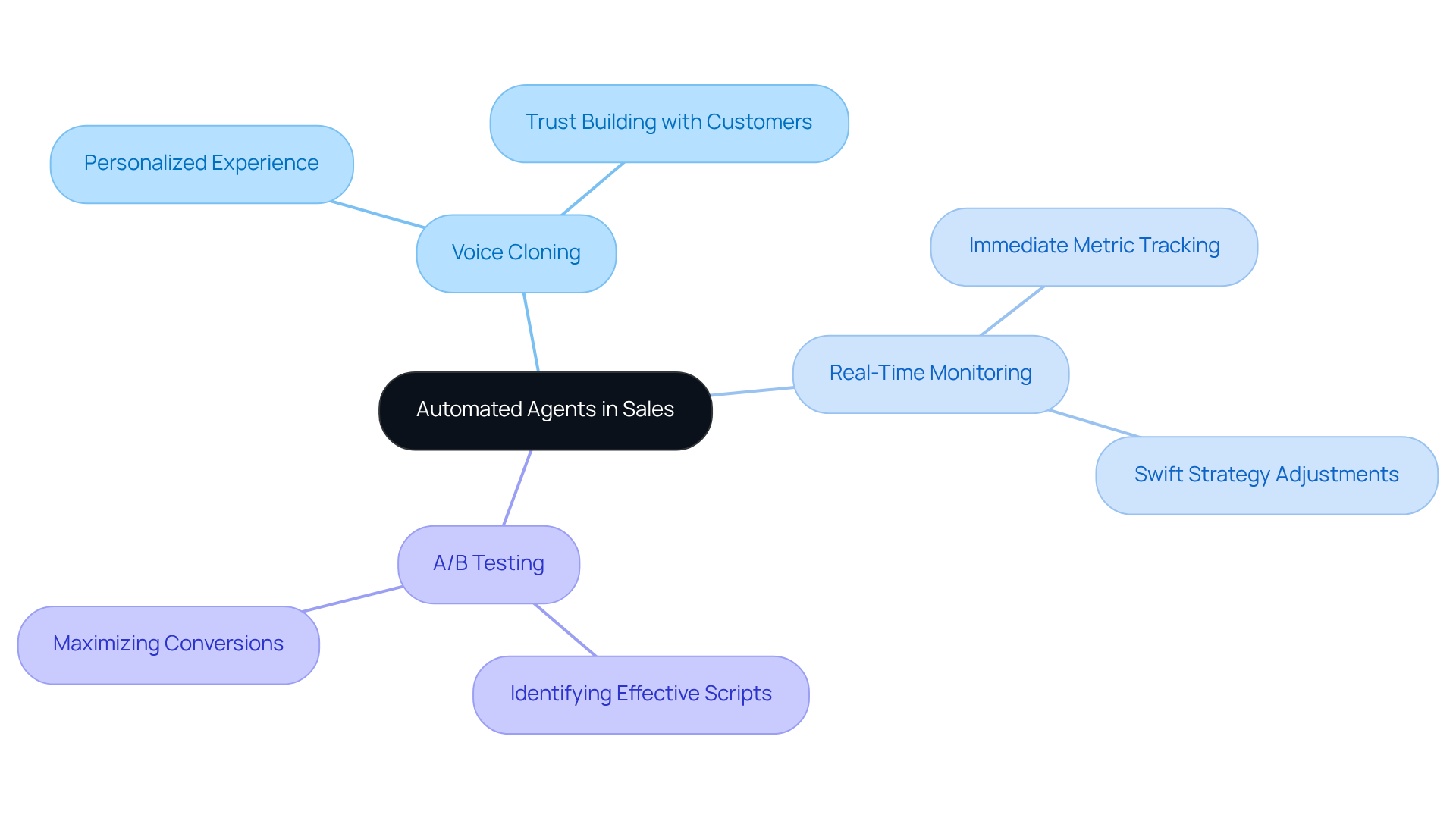
- Voice Cloning: Clone voices from top-performing human agents to craft a personalized experience that fosters trust with customers.
- Real-Time Monitoring: Track changes in key metrics within minutes of launching a new script or voice, facilitating swift strategy adjustments.
- A/B Testing: Conduct A/B tests to identify the most effective scripts and methods for maximizing conversions.
A recent study reveals that businesses utilizing an automated agent saw a remarkable 120% increase in qualified leads and a 35% reduction in operational costs. Furthermore, revenue teams leveraging Intone's AI voice automation with an automated agent are 1.3 times more likely to achieve revenue growth, underscoring the effectiveness of AI in enhancing performance. As Adam Alfano notes, alleviating routine tasks for sales personnel enables them to concentrate on strategic relationship-building activities. This underscores the transformative potential of an automated agent in boosting revenue performance, as the role of AI in commerce transitions from optional to essential.
Implement Effective Strategies for Automated Agent Integration
To effectively incorporate automated assistants into your marketing procedures, consider these strategies:
-
Assess Current Workflows: Start by evaluating your existing sales workflows. Identify areas where automation can add significant value. Recent studies show that teams leveraging AI-powered automation, such as Intone's AI voice assistants, can achieve a remarkable 1.5x increase in conversion rates, greatly enhancing productivity.
-
Choose the Right Technology: Selecting the right AI tools is crucial. Opt for solutions that align with your specific needs and ensure compatibility with your existing systems. Intone’s customizable AI voice assistants can be tailored to follow your exact scripts and scale across millions of calls, making them an ideal choice. Their real-time voice stack guarantees smooth interactions, even during peak volumes.
-
Train Your Team: Comprehensive training for your sales team is essential. Equip them with the skills to collaborate effectively with automated systems, emphasizing the importance of teamwork.
-
Monitor Performance: Establish key performance indicators (KPIs) to track the effectiveness of your automated agent. Regular monitoring allows for necessary adjustments. Businesses that actively track performance often see significant reductions in response times and improved client engagement. For instance, 91% of sales teams utilizing AI have maintained or improved their win rates, even amidst economic challenges.
By implementing these strategies and leveraging Intone's AI voice assistants, businesses can enhance their sales processes, stimulate growth, and elevate client satisfaction.

Measure Success and Optimize Automated Agent Performance
To effectively evaluate the success of an automated agent, it is essential to focus on key performance indicators (KPIs). Metrics such as conversion rates, client satisfaction scores, and response times serve as critical benchmarks. Regular performance reviews are crucial for assessing these metrics and identifying areas for improvement.
For instance, monitoring average handling time (AHT) provides insights into how effectively representatives address inquiries. In the financial services sector, the average AHT typically ranges from 6 to 8 minutes per interaction. By employing real-time analytics, businesses can make prompt modifications to scripts or workflows, significantly improving responsiveness to client needs.
Companies that proactively oversee and enhance their automated agent systems, such as GCS with customizable AI voice solutions, have reported substantial advantages. These include:
- Up to a 25% increase in customer satisfaction
- A remarkable 40% boost in conversion rates
The 24/7 AI representatives and intelligent analytics features empower sales leaders in finance to utilize AI tools effectively, enhancing overall efficiency in selling.
In summary, by concentrating on KPIs and leveraging real-time analytics, businesses can not only enhance their automated agent systems but also drive significant growth in customer satisfaction and conversion rates.

Learn from Industry Leaders: Case Studies on Automated Agent Success
Industry leaders are increasingly leveraging automated agents in their sales processes, yielding impressive outcomes. For instance, a prominent finance firm reported a staggering 50% increase in lead conversion rates after implementing AI voice assistants for initial customer interactions. This aligns with research indicating that sales teams utilizing AI can see a 15% boost in conversion rates. The seamless integration of these systems allows companies to upload scripts and training materials, tailoring the AI to meet their specific needs.
Moreover, businesses benefit from 24/7 AI representatives, ensuring constant support for customer interactions. A telecom provider that adopted automated systems for payment reminders noted a 30% decrease in overdue accounts, reflecting a broader trend where 30-40% of daily administrative tasks can be automated with AI. With Intone's intelligent analytics, organizations can track performance, compare representatives, and gain actionable insights in real-time.
These case studies highlight the diverse applications of automated agents across various sectors and their considerable effect on sales performance. However, it’s crucial for businesses to recognize potential challenges in AI implementation, such as integration hurdles and the necessity for staff training. By analyzing these successes and challenges, companies can glean valuable insights into effective strategies while identifying pitfalls to avoid.

Conclusion
Automated agents have emerged as essential tools in the sales landscape, fundamentally reshaping how businesses engage with customers and optimize their operations. By leveraging advanced AI technologies, organizations can streamline processes, enhance lead qualification, and drive significant improvements in sales performance. The integration of these automated systems is no longer a luxury; it’s a necessity for companies striving to remain competitive in an increasingly digital marketplace.
Key insights illustrate the multifaceted benefits of automated agents, including substantial increases in conversion rates and customer satisfaction. With strategies such as:
- Real-time monitoring
- A/B testing
- Comprehensive team training
businesses can effectively harness the power of AI to improve efficiency and foster stronger relationships with clients. Case studies highlight remarkable successes achieved by industry leaders who have embraced these technologies, showcasing the potential for sustained growth and success.
As organizations look to the future, the importance of adopting automated agents cannot be overstated. Implementing these solutions is a strategic move that can lead to enhanced sales performance and operational efficiency. Embracing automated agents today ensures that businesses are well-equipped to navigate the challenges of tomorrow’s market. The time to act is now; investing in these innovative tools will pave the way for a more productive and profitable sales environment.
Frequently Asked Questions
What are automated agents in sales?
Automated agents are advanced AI systems that optimize various sales processes, such as lead qualification, payment reminders, and client support, allowing human representatives to focus on more complex interactions.
How do automated agents improve sales performance?
Automated agents analyze client data to identify high-intent leads, which significantly boosts conversion rates and creates upselling opportunities.
What are the key benefits of Intone's AI voice agents?
The key benefits include voice cloning for personalized customer experiences, real-time monitoring of key metrics for quick strategy adjustments, and A/B testing to identify the most effective scripts for maximizing conversions.
What impact do automated agents have on lead generation and operational costs?
Businesses using automated agents have experienced a 120% increase in qualified leads and a 35% reduction in operational costs.
How does Intone's AI voice automation affect revenue growth?
Revenue teams using Intone's AI voice automation with automated agents are 1.3 times more likely to achieve revenue growth.
What does Adam Alfano emphasize about the role of automated agents in sales?
Adam Alfano emphasizes that alleviating routine tasks for sales personnel allows them to focus on strategic relationship-building activities, highlighting the transformative potential of automated agents in boosting revenue performance.