

Introduction
Text clustering has emerged as a powerful technique in the finance sector, enabling organizations to efficiently sift through vast amounts of customer data. By grouping similar pieces of text, sales teams can uncover valuable insights into customer preferences and pain points. This ultimately leads to more effective sales strategies. However, a pressing challenge remains: how can businesses fully harness the potential of text clustering to enhance their understanding of client needs and drive tangible sales results?
To address this, companies must not only adopt text clustering but also integrate it into their strategic frameworks. By doing so, they can transform raw data into actionable insights, paving the way for improved customer engagement and increased revenue.
Understand Text Clustering and Its Relevance to Sales
Text clustering is a powerful machine learning technique that organizes similar pieces of text based on their content. In the competitive landscape of marketing tactics, particularly within finance, this method enables organizations to analyze substantial amounts of customer interactions, feedback, and inquiries effectively. By grouping these texts, sales teams can identify shared themes, customer challenges, and preferences, which can significantly enhance their sales presentations and approaches.
For instance, when customer feedback is grouped, it can reveal common issues that demand attention. This insight allows sales teams to adjust their strategies accordingly, ensuring they address the most pressing concerns of their clients. Such an approach not only deepens the understanding of customer requirements but also streamlines the qualification process by focusing on high-intent prospects.
Ultimately, leveraging text clustering can lead to more tailored and effective sales strategies, driving better results and fostering stronger customer relationships.

Implement K-means Clustering for Effective Lead Qualification
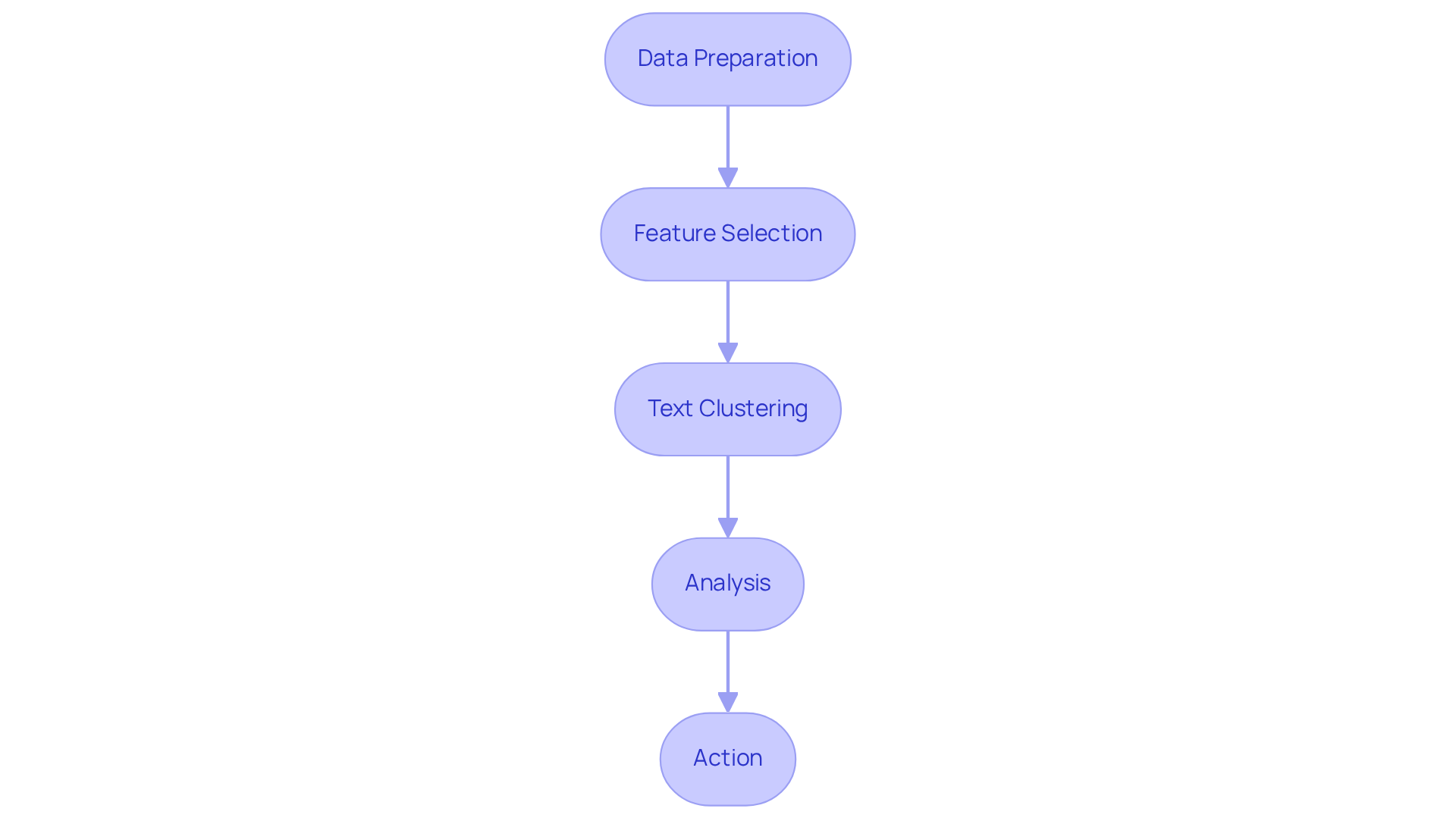
K-means text clustering stands out as a powerful algorithm for partitioning data into distinct groups based on similarity. To effectively implement K-means for prospect qualification, consider the following steps:
- Data Preparation: Start by gathering relevant data points, including customer demographics, past interactions, and engagement levels. This foundational step is crucial for accurate analysis.
- Feature Selection: Next, identify key characteristics that influence prospect quality. Focus on metrics such as response rates and purchase history, which can significantly impact your outcomes.
- Text clustering involves utilizing the K-means algorithm to divide prospects into groups. Each group will represent a collection of prospects sharing comparable traits, allowing for targeted strategies.
- Analysis: Assess these groups to determine which ones exhibit the greatest conversion potential. This analysis is vital for prioritizing your efforts effectively.
- Action: Finally, customize your marketing strategies for each group. Concentrate on high-potential prospects with personalized messaging. For instance, a finance company may discover that leads who have previously engaged with educational content are more likely to convert. This insight enables them to prioritize these leads in their outreach efforts, maximizing their chances of success.
Evaluate Clustering Results to Optimize Sales Strategies
To effectively evaluate your clustering results and optimize sales strategies, consider these key metrics:
- Silhouette Score: This metric evaluates how closely related an object is to its own group compared to other groups. In text clustering, a higher Silhouette Score signifies well-defined groups, enhancing the clarity of your segmentation.
- Inertia: This measures the compactness of groups; lower inertia values indicate that the groups are tightly packed, which is desirable for effective targeting.
- Calinski-Harabasz Index: This index assesses the quality of grouping by measuring the ratio of between-group dispersion to within-group dispersion. Higher scores in text clustering signify more distinctly defined groups, making it a valuable measure for evaluating the effectiveness of grouping.
- Conversion Rates: Analyze the conversion rates of leads within each cluster to identify which segments yield the highest performance. For instance, statistics show that focused marketing campaigns can boost conversion rates by as much as 20% when leveraging grouping insights.
- Feedback Loop: Establish a feedback system to continuously refine your grouping strategy based on revenue results. If a particular group shows low conversion rates, review the attributes used for grouping and make necessary adjustments. This iterative process ensures your sales strategies remain responsive to customer behaviors and preferences, ultimately driving better results.
Be mindful of common pitfalls in group analysis, such as overfitting data or misinterpreting results, which can undermine the effectiveness of your strategies.

Leverage AI and Analytics to Enhance Clustering Outcomes
Incorporating AI and analytics into your grouping processes can significantly enhance outcomes. Here are some effective strategies that can transform your approach:
- Natural Language Processing (NLP): Leverage NLP methods to preprocess text data, extracting significant attributes that enhance grouping accuracy. For instance, NLP can analyze customer interactions to identify key themes and sentiments, leading to more precise segmentation of prospects.
- Predictive Analytics: Implement predictive models to forecast lead behavior based on grouping results. This enables proactive engagement strategies. By understanding which clusters are likely to convert, sales teams can tailor their approaches effectively.
- Real-time Data Analysis: Utilize real-time analytics to continuously monitor and adjust grouping parameters based on incoming data. This adaptability ensures that your strategies remain relevant and responsive to market changes.
- Visualization Tools: Employ data visualization tools to graphically depict grouping results, making it easier to identify patterns and insights. For example, a finance firm could use visual dashboards to track the effectiveness of various lead clusters, allowing for swift modifications to their marketing strategies.
The impact of NLP on enhancing text clustering outcomes is profound; it not only boosts the accuracy of segmentations but also empowers sales teams to engage more effectively with their target audiences. By adopting these strategies, you can elevate your grouping processes and drive better results.

Conclusion
Text clustering stands out as a powerful strategy in the finance sector, allowing sales teams to leverage data effectively to refine their approaches and boost customer engagement. By categorizing similar texts, organizations can reveal valuable insights that shape tailored sales strategies, ultimately leading to enhanced outcomes and stronger client relationships.
This article has delved into the numerous advantages of text clustering, underscoring the significance of techniques like K-means for effective lead qualification and the assessment of clustering results. Key metrics such as Silhouette Score, Inertia, and conversion rates offer critical insights into the effectiveness of segmentation. Moreover, the integration of AI and analytics further sharpens the precision and adaptability of these strategies.
The importance of text clustering in sales is profound; it not only streamlines the qualification process but also empowers sales teams to make data-driven decisions that align with customer needs. Embracing these techniques and continuously optimizing strategies based on analytical feedback is vital for organizations aiming to excel in a competitive landscape. By prioritizing text clustering, finance professionals can elevate their sales strategies and drive sustainable growth.
Frequently Asked Questions
What is text clustering?
Text clustering is a machine learning technique that organizes similar pieces of text based on their content.
How is text clustering relevant to sales?
Text clustering helps sales teams analyze large amounts of customer interactions, feedback, and inquiries, allowing them to identify shared themes, customer challenges, and preferences.
What benefits does text clustering provide for sales teams?
It enables sales teams to adjust their strategies based on common issues revealed in customer feedback, ensuring they address pressing concerns and focus on high-intent prospects.
How does text clustering improve understanding of customer requirements?
By grouping customer feedback, text clustering reveals common issues and preferences, deepening the understanding of what customers need.
What impact does text clustering have on sales strategies?
Leveraging text clustering can lead to more tailored and effective sales strategies, driving better results and fostering stronger customer relationships.
List of Sources
- Evaluate Clustering Results to Optimize Sales Strategies
- 7 Evaluation Metrics for Clustering Algorithms | Towards Data Science (https://towardsdatascience.com/7-evaluation-metrics-for-clustering-algorithms-bdc537ff54d2)
- Clustering Stores in Retail to Increase Sales (https://datawiz.io/en/blog/clustering-stores-in-retail-to-increase-sales)
- Advanced Clustering Techniques for Effective Marketing Campaigns (https://tellix.ai/advanced-clustering-techniques-for-effective-marketing-campaigns)
- Smarter Paid Media: Using Data Clustering to Drive Sales (https://trimarkdigital.com/blog/using-data-clustering-to-drive-smarter-paid-media-marketing)
- From Chaos to Clarity: How Clustering Transforms Sales Rep Efficiency (https://shaun-enslin.medium.com/from-chaos-to-clarity-how-clustering-transforms-sales-rep-efficiency-cdc60ae7ea3f)
- Leverage AI and Analytics to Enhance Clustering Outcomes
- How AI is redefining sales forecasting (https://sap.com/resources/how-ai-redefines-sales-forecasting)
- The Role of Artificial Intelligence (AI) in Sales in 2025 (https://gartner.com/en/sales/topics/sales-ai)
- A New Era of Data Insights: How Augmented Analytics is Transforming Sales (https://salesforce.com/in/resources/articles/how-augmented-analytics-is-transforming-sales)
- 75 statistics about AI in B2B sales and marketing (https://sopro.io/resources/blog/ai-sales-and-marketing-statistics)
- Smarter Paid Media: Using Data Clustering to Drive Sales (https://trimarkdigital.com/blog/using-data-clustering-to-drive-smarter-paid-media-marketing)