
Introduction
In the fast-paced realm of customer service, the average speed of answer (ASA) stands out as a pivotal metric that can significantly influence client satisfaction. As businesses aim to boost their responsiveness, a range of innovative tools and technologies has emerged, designed to streamline operations and minimize wait times. This article explores ten powerful solutions tailored to optimize ASA in call centers, showcasing how organizations can harness these advancements to not only meet but surpass customer expectations. With a multitude of options available, the pressing question is: which tools will genuinely transform call center performance and elevate the customer experience?
Intone: Enhance Average Speed of Answer with AI Voice Agents
Intone's are revolutionizing customer service by dramatically improving the . By automating essential functions like , , and , these advanced systems ensure that inquiries are handled swiftly and efficiently.
Employing sophisticated machine learning algorithms, Intone's representatives can manage thousands of inquiries simultaneously, connecting clients to the right resources without delay. This capability not only but also significantly elevates the , which in turn enhances overall . With and immediate responses to frequently asked questions, businesses can foster a more positive .
For instance, Vodafone New Zealand experienced a remarkable 35% reduction in handling time after implementing , underscoring the tangible benefits of this technology. Furthermore, these AI systems can respond to initial inquiries in as little as three seconds, a stark contrast to the typical 2 to 5 seconds required by human agents.
By optimizing operations and enhancing responsiveness, Intone's solutions empower businesses to not only meet but exceed client expectations in today's fast-paced environment. Embrace the future of customer service with Intone's and witness the transformation in your and .

8x8: Optimize Call Center Performance with Advanced ASA Tools
Smart routing of inquiries is a game-changer for and significantly improving the . By directing inquiries to the most suitable representatives based on their skills and availability, service centers can and elevate client satisfaction. Organizations that have embraced report notable , with industry benchmarks highlighting that the indicates 80% of inquiries should be resolved within 20 seconds to meet client expectations.
Contact center managers have witnessed the efficiency of these systems. They assert that not only but also alleviates the workload on agents, allowing them to focus on resolving customer issues more effectively. This approach has been proven to , as evidenced by case studies where companies significantly improved their metrics after implementing advanced routing technologies.
Moreover, integrating and workforce management tools empowers managers to oversee communication flows and adjust staffing dynamically. This flexibility ensures that agents are available during peak periods, further enhancing response times. As a result, can achieve a more responsive and customer-centric operation, ultimately leading to higher satisfaction rates and improved business outcomes.

CallMiner: Leverage Analytics to Boost Average Speed of Answer
Call centers can significantly enhance their by leveraging to identify bottlenecks in their processes. By carefully examining communication data, managers can reveal trends and patterns that lead to extended waiting periods. A compelling study demonstrated that organizations utilizing noted a and a 9% decrease in processing duration. This underscores the potential of analytics in streamlining operations.
Applying insights from data analysis enables focused enhancements. For instance, optimizing staffing levels during peak times and refining communication routing protocols can lead to substantial improvements. With Intone's , managers can establish data sources and transfer rules that enhance client interaction and improve response times. Furthermore, facilitates , further elevating client satisfaction.
As industry experts emphasize, understanding the root causes of performance gaps is crucial for guiding effective enhancements. Ongoing observation of center statistics is vital for adjusting strategies to meet the increasing demands of clients for prompt support. As Peter Sondergaard aptly states, 'Data is only valuable when properly mined and analyzed,' highlighting the importance of effective data handling in enhancing the .
Moreover, the industry standard for responding to inquiries is referred to as the (ASA), which is to respond to 80% of inquiries within 20 seconds, establishing a benchmark for centers to aim for. By embracing these strategies, call centers can not only meet but exceed client expectations, ensuring a competitive edge in the market.

Dialpad: Streamline Call Routing for Faster Response Times
Dialpad's stand out in the realm of contact center technology, offering both skill-based and . This strategic approach ensures that calls reach the most qualified agents, significantly reducing client wait times and enhancing the chances of achieving . In fact, organizations that implement often see , setting a benchmark for service excellence.
Moreover, elevates the client experience by swiftly addressing high-value inquiries, which not only decreases average wait times but also fosters client loyalty. Experts in contact center technology emphasize that effective routing systems are vital for .
By adopting these advanced routing strategies, call centers can markedly enhance their . This leads to improved performance and higher client retention rates, making it clear that investing in intelligent call routing is not just beneficial - it's essential for success in today's competitive landscape.

Five9: Cloud Solutions for Enhanced Average Speed of Answer
Cloud-based solutions significantly enhance the by integrating multiple communication channels. This allows clients to connect with support through their preferred methods-be it phone, chat, or email-thereby reducing wait times and boosting overall satisfaction. Organizations that have adopted such strategies report a remarkable 33% improvement in , as customers value the flexibility and responsiveness of their interactions.
Moreover, Intone's simplify implementation and personalization. Sales managers can easily upload scripts, training resources, and conversation recordings tailored to their specific business needs. With , managers can establish data sources and , while enable them to track performance and adjust resources dynamically based on call volume trends.
By leveraging these features, Intone plays a crucial role in providing an , improving ASA, streamlining operations, and fostering a more engaging client experience. This ultimately leads to higher retention rates and increased loyalty.

Call Center Studio: Benchmark and Improve Your ASA Metrics
Call Center Studio offers vital tools for benchmarking the against industry standards, which typically aim for an . This benchmark is essential, as 90% of customers deem a quick response critical, highlighting the need to enhance . By regularly evaluating performance, contact centers can identify shortcomings in their response times and .
For instance, organizations that leverage historical data to forecast busy periods can , ensuring adequate agents are available to handle peak volumes. This proactive strategy not only boosts response times but also contributes to a . Industry experts emphasize that focusing on can lead to better , as customers who receive prompt attention are more likely to articulate their concerns clearly.
Furthermore, with , the urgency for effective ASA strategies has never been greater. By embracing these strategies, contact centers can significantly enhance their service delivery and overall . To implement these improvements, consider conducting and adjusting staffing based on projected inquiry volumes.

Genesys Cloud: Monitor Agent Performance to Improve ASA
Genesys Cloud offers robust monitoring tools that empower managers to track representative performance in real-time. By analyzing key metrics such as and resolution rates, contact centers can pinpoint specific areas where representatives may require additional training or support. This proactive approach not only enhances the but also ensures that representatives are equipped to handle inquiries effectively.
Organizations that implement have seen significant reductions in AHT. In fact, benchmarks reveal that top-performing centers maintain an AHT of around 7 to 10 minutes. Call center supervisors emphasize the necessity of ongoing training; as one supervisor noted, "Investing in our representatives' skills directly correlates with improved efficiency and client satisfaction."
Moreover, facilitates immediate adjustments, allowing teams to swiftly address . By leveraging these insights, service centers can foster a culture of , ultimately leading to enhanced client experiences and loyalty.

PolyAI: Automate Customer Interactions for Faster ASA
PolyAI stands at the forefront of automating with its advanced . These agents are expertly designed to handle a variety of tasks, from answering frequently asked questions to processing transactions. This level of automation dramatically reduces the number of calls that require human intervention, leading to a notable improvement in the .
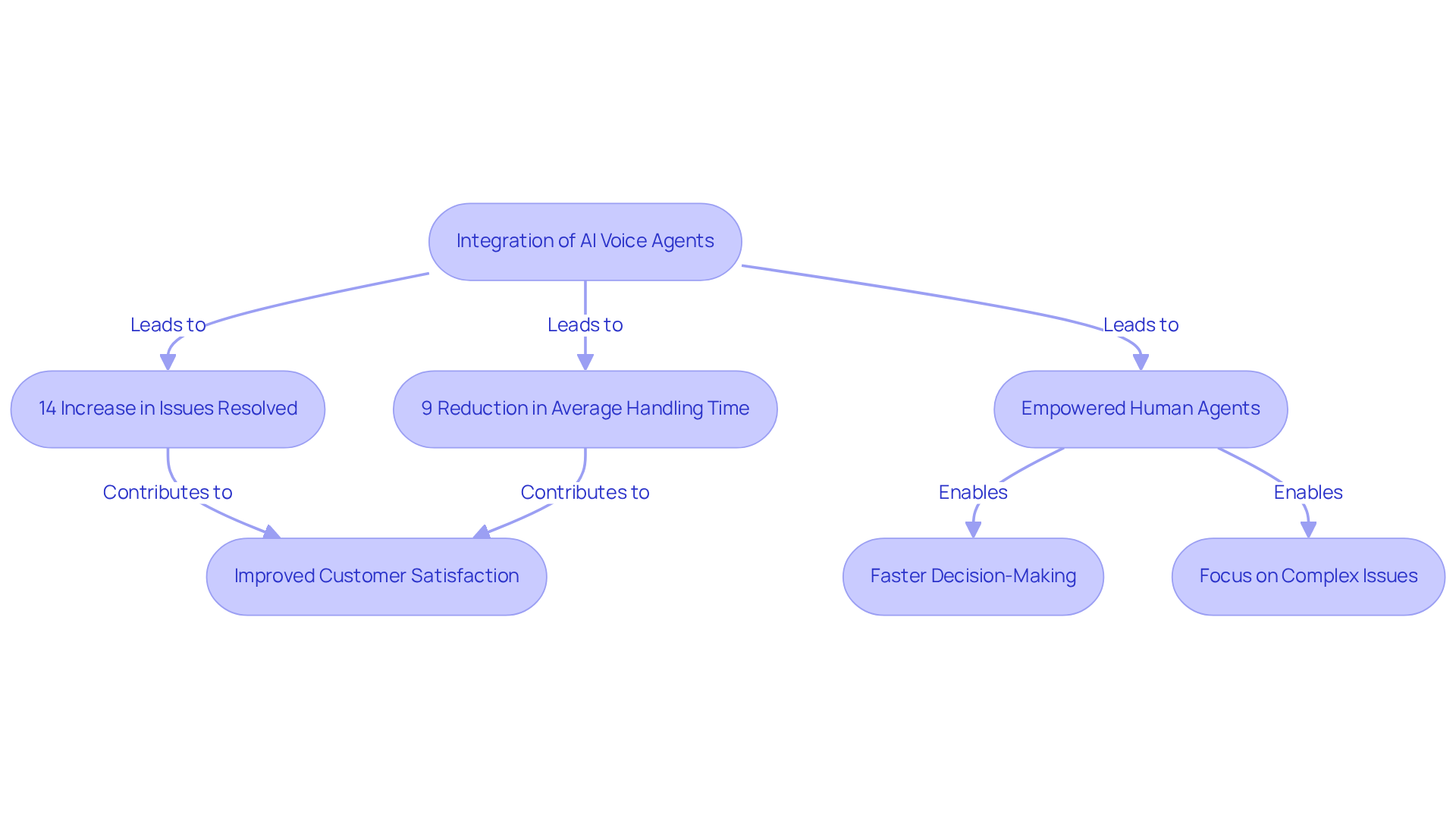
Consider this: contact centers that have integrated report a remarkable 14% increase in issues resolved per hour, alongside a 9% reduction in . By streamlining these interactions, human representatives can dedicate their efforts to more complex issues that demand personal attention and empathy.
Take Golden Nugget, for instance. This organization has successfully implemented to quickly assess client communications, which facilitates faster decision-making and enhances service quality. Such real-world applications underscore the tangible benefits of in optimizing contact center operations and elevating .
In summary, the integration of AI in customer service not only boosts efficiency but also empowers human agents to focus on what truly matters - providing personalized support. Embracing these technologies is not just a trend; it’s a strategic move towards a more effective and customer-centric approach.
Observe.AI: Utilize AI Insights to Enhance ASA
from platforms like Observe.AI are pivotal in analyzing center interactions, allowing managers to identify trends that significantly impact . By pinpointing the , center leaders can implement to address these issues effectively.
For example, organizations that have adopted report remarkable enhancements in response times. Some have seen a 14% increase in issues resolved per hour after refining their processes. This focus on not only boosts ASA but also improves the , ensuring that calls are handled with greater effectiveness and efficiency.
As the industry continues to evolve, leveraging these insights is essential for maintaining a competitive edge and meeting the growing expectations of customers. Embracing is not just a choice; it's a necessity for those aiming to excel in today's fast-paced environment.

Call Centre Helper: Practical Tips for Improving Average Speed of Answer
To enhance the , it is crucial to . Ensuring a sufficient number of agents are present during busy periods can significantly reduce wait times. For instance, allow contact centers to anticipate demand based on historical data, aligning staffing with call volume. This strategy has proven effective; companies that have improved their staffing levels report a notable decrease in wait times and increased .
Real-world examples underscore this point:
- PolyAI's collaboration with Carnival UK resulted in a up to 14% of calls, freeing human representatives to focus on more complex inquiries. This not only boosted response rates but also enriched the overall customer experience.
Industry experts emphasize the importance of having the right representatives available during peak times. As one expert noted, "A low ASA contributes to a favorable first impression, showing clients that their time is valued." Additionally, ensures they are equipped to handle inquiries efficiently, further .
By adopting , centers can enhance their , which leads to and increased customer loyalty. and adjusting them according to call patterns is essential for maintaining operational efficiency and elevating .

Conclusion
In the pursuit of enhancing the average speed of answer (ASA) in call centers, integrating innovative tools and technologies is crucial. This article has delved into a range of solutions, from AI voice agents to advanced analytics, all aimed at streamlining operations and improving response times. By adopting these strategies, organizations can not only meet but exceed customer expectations, fostering a more efficient and satisfying service experience.
Key insights include:
- The effectiveness of AI-driven tools like Intone and PolyAI, which automate customer interactions and significantly reduce the need for human intervention, leading to faster response times.
- Intelligent routing systems, such as those offered by 8x8 and Dialpad, ensure inquiries are directed to the most qualified agents, minimizing wait times.
- The role of real-time analytics, highlighted by CallMiner and Observe.AI, empowers managers to identify bottlenecks and implement targeted improvements, ultimately enhancing overall performance.
As the customer service landscape evolves, embracing these advanced technologies is essential for maintaining a competitive edge. Organizations are urged to leverage these tools not just to improve ASA metrics but to cultivate a customer-centric approach that prioritizes efficiency and satisfaction. By focusing on these strategies, call centers can significantly elevate their service delivery, ensuring responsiveness to the ever-growing demands of their clientele.
Frequently Asked Questions
What is the purpose of Intone's AI voice assistants?
Intone's AI voice assistants aim to revolutionize customer service by improving the average speed of answer (ASA) through automation of functions like lead qualification, payment reminders, and client support interactions.
How do Intone's AI voice assistants enhance customer service?
They enhance customer service by managing thousands of inquiries simultaneously, reducing wait times, and providing immediate responses to frequently asked questions, which leads to higher customer satisfaction.
Can you provide an example of the effectiveness of Intone's AI voice assistants?
Vodafone New Zealand experienced a 35% reduction in handling time after implementing AI voice assistants, demonstrating the tangible benefits of this technology.
What is the average response time of Intone's AI systems compared to human agents?
Intone's AI systems can respond to initial inquiries in as little as three seconds, while human agents typically take 2 to 5 seconds.
What strategies does 8x8 recommend for optimizing call center performance?
8x8 recommends smart routing of inquiries to suitable representatives based on their skills and availability, which can significantly improve average speed of answer and client satisfaction.
What industry benchmark is suggested for average speed answer (ASA)?
The industry benchmark suggests that 80% of inquiries should be resolved within 20 seconds to meet client expectations.
How do real-time analytics and workforce management tools benefit contact centers?
They allow managers to oversee communication flows and dynamically adjust staffing, ensuring agents are available during peak periods, which enhances response times.
What role does analytics play in improving average speed of answer in call centers?
Analytics helps identify bottlenecks in processes, allowing managers to optimize staffing levels and communication routing, which can lead to significant improvements in response times.
What is the importance of understanding performance gaps in call centers?
Understanding performance gaps is crucial for guiding effective enhancements and adjusting strategies to meet client demands for prompt support.
What is the significance of the average speed answer (ASA) in the industry?
ASA serves as a benchmark for call centers, indicating the standard for responding to inquiries, which helps ensure they meet or exceed client expectations.
List of Sources
- Intone: Enhance Average Speed of Answer with AI Voice Agents
- How AI Voice Assistants Improve Response & Reduce Wait Time | blog (https://codiste.com/ai-voice-assistants-reduce-customer-wait-time-response-speed)
- Call Center Statistics You Need to Know in 2025 | Xima Software (https://ximasoftware.com/blog/call-center-statistics)
- 35+ Call Center Statistics for 2025 | LiveAgent - Help Desk Software & Live Chat (https://liveagent.com/blog/call-center-statistics)
- Inbound AI Voice Agents: The Game Changer for Call Centers (https://idtexpress.com/blog/inbound-ai-voice-agents-the-game-changer-for-call-centers)
- hiringbranch.com (https://hiringbranch.com/blog/call-center-statistics)
- 8x8: Optimize Call Center Performance with Advanced ASA Tools
- 8x8 Makes Workforce Management Native in Every Contact Center Seat at No Extra Cost | 8x8, Inc. (https://investors.8x8.com/news-releases/news-release-details/8x8-makes-workforce-management-native-every-contact-center-seat)
- Customers Resolve Issues Faster With New AI, Omnichannel Enhancements From 8x8 | 8x8, Inc. (https://investors.8x8.com/news-releases/news-release-details/customers-resolve-issues-faster-new-ai-omnichannel-enhancements)
- Call Center Statistics You Need to Know in 2025 | Xima Software (https://ximasoftware.com/blog/call-center-statistics)
- 8x8 Delivers Latest AI Advancements and Customer Engagement Capabilities to Cloud CX Platform (https://businesswire.com/news/home/20241107677114/en/8x8-Delivers-Latest-AI-Advancements-and-Customer-Engagement-Capabilities-to-Cloud-CX-Platform)
- What is Average Speed of Answer? Strategies and Calculation 1 (https://callcenterstudio.com/blog/what-is-average-speed-of-answer-strategies-and-calculation)
- CallMiner: Leverage Analytics to Boost Average Speed of Answer
- How to Measure & Improve Average Speed of Answer (https://callminer.com/blog/improve-call-center-average-speed-of-answer)
- careerfoundry.com (https://careerfoundry.com/en/blog/data-analytics/inspirational-data-quotes)
- Call Center Statistics You Need to Know in 2025 | Xima Software (https://ximasoftware.com/blog/call-center-statistics)
- 26 Call Center Statistics That Reveal Where AI Is Actually Working in 2026 (https://cmswire.com/contact-center/16-important-call-center-statistics-to-know-about)
- Important Call Center Statistics to Know [2025] | Sprinklr (https://sprinklr.com/blog/call-center-statistics)
- CallMiner New Release Increases Speed to Intelligence (https://callminer.com/news/press-releases/callminer-increases-speed-to-intelligence-from-customer-interactions-with-latest-software-release)
- CallMiner's AI-Powered CX and Customer Feedback Solution (https://callminer.com/news/press-releases/callminer-revolutionizes-cx-with-ai-powered-customer-feedback-solution-outreach)
- callminer.com (https://callminer.com/news/in-the-news)
- Dialpad: Streamline Call Routing for Faster Response Times
- The Ultimate Guide to Average Speed of Answer (ASA) (https://callcentrehelper.com/guide-to-average-speed-of-answer-254580.htm)
- dialpad.com (https://dialpad.com/features/call-routing)
- hiringbranch.com (https://hiringbranch.com/blog/call-center-statistics)
- State Retail Water Corporation - KJR (https://kjr.com.au/case_studies/state-retail-water-corporation)
- Enhance Contact Center Skills with Average Speed of Answer (https://convin.ai/blog/average-speed-of-answer)
- Five9: Cloud Solutions for Enhanced Average Speed of Answer
- five9.com (https://five9.com/blog/important-contact-center-statistics-2025)
- Important Call Center Statistics to Know [2025] | Sprinklr (https://sprinklr.com/blog/call-center-statistics)
- 35+ Call Center Statistics for 2025 | LiveAgent - Help Desk Software & Live Chat (https://liveagent.com/blog/call-center-statistics)
- 44 Call Center Statistics and Metrics You Should Know | Smith.ai (https://smith.ai/blog/call-center-statistics)
- Five9 Focuses on Latest Cloud Contact Center Software Trends at Call Center Week | Five9, Inc. (https://investors.five9.com/news-releases/news-release-details/five9-focuses-latest-cloud-contact-center-software-trends-call)
- Call Center Studio: Benchmark and Improve Your ASA Metrics
- The Ultimate Guide to Average Speed of Answer (ASA) (https://callcentrehelper.com/guide-to-average-speed-of-answer-254580.htm)
- Understanding Average Speed of Answer (ASA) in Contact Centers | Observe.AI Contact Center Glossary (https://observe.ai/contact-center-glossary/what-is-average-speed-of-answer-call-centers)
- 26 Call Center Statistics That Reveal Where AI Is Actually Working in 2026 (https://cmswire.com/contact-center/16-important-call-center-statistics-to-know-about)
- Important Call Center Statistics to Know [2025] | Sprinklr (https://sprinklr.com/blog/call-center-statistics)
- Genesys Cloud: Monitor Agent Performance to Improve ASA
- Transform agent performance with real-time insights and QA (https://genesys.com/blog/post/transforming-agent-performance-with-real-time-insights-and-purpose-driven-qa)
- Top contact center statistics & benchmarks (2025) (https://plivo.com/blog/contact-center-statistics-benchmarks-2025)
- Call Center Statistics You Need to Know in 2025 | Xima Software (https://ximasoftware.com/blog/call-center-statistics)
- Genesys Cloud – New Virtual Agent Performance dashboard offers clear insights for all stakeholders - Genesys Cloud Resource Center (https://rcworkbench.genesys.cloud/announcements/genesys-cloud/new-virtual-agent-performance-dashboard-offers-clear-insights-for-all-stakeholders)
- Important Call Center Statistics to Know [2025] | Sprinklr (https://sprinklr.com/blog/call-center-statistics)
- Top 110 Call Center Quotes To Motivate You and Your Agents - CloudTalk (https://cloudtalk.io/blog/top-110-call-center-quotes)
- PolyAI: Automate Customer Interactions for Faster ASA
- Important Call Center Statistics to Know [2025] | Sprinklr (https://sprinklr.com/blog/call-center-statistics)
- PolyAI launches agentic AI team to drive CX insights and growth: QA, Analyst, and Builder Agents - PolyAI (https://poly.ai/blog/polyai-launches-agentic-ai-team)
- Call Center Statistics You Need to Know in 2025 | Xima Software (https://ximasoftware.com/blog/call-center-statistics)
- No More Waiting: How PolyAI Is Changing the Game of Customer Service - Global Industry Herald (https://globalindustryherald.com/news/no-more-waiting-how-polya-is-changing-the-game-of-customer-service)
- Hello Sugar chooses PolyAI voice agents to scale and automate exceptional customer experiences (https://prnewswire.com/news-releases/hello-sugar-chooses-polyai-voice-agents-to-scale-and-automate-exceptional-customer-experiences-302528434.html)
- Observe.AI: Utilize AI Insights to Enhance ASA
- How to Measure & Improve Average Speed of Answer (https://callminer.com/blog/improve-call-center-average-speed-of-answer)
- The Ultimate Guide to Average Speed of Answer (ASA) (https://callcentrehelper.com/guide-to-average-speed-of-answer-254580.htm)
- Call Center Statistics You Need to Know in 2025 | Xima Software (https://ximasoftware.com/blog/call-center-statistics)
- Important Call Center Statistics to Know [2025] | Sprinklr (https://sprinklr.com/blog/call-center-statistics)
- 75 Quotes About AI: Business, Ethics & the Future (https://deliberatedirections.com/quotes-about-artificial-intelligence)
- Observe.AI launches Real-Time AI to help contact centers drive sales and retain customers with end-to-end Conversation Intelligence (https://observe.ai/press-releases/observe-ai-launches-real-time-ai)
- Call Centre Helper: Practical Tips for Improving Average Speed of Answer
- A Guide to Average Speed of Answer (ASA) in the Call Center (https://verint.com/blog/a-guide-to-average-speed-of-answer-asa-in-the-call-center)
- The Ultimate Guide to Average Speed of Answer (ASA) (https://callcentrehelper.com/guide-to-average-speed-of-answer-254580.htm)
- How to Measure & Improve Average Speed of Answer (https://callminer.com/blog/improve-call-center-average-speed-of-answer)
- Calculate & improve average speed of answer (+ formula) (https://poly.ai/blog/average-speed-of-answer)