
Introduction
AI voice cloning technology is revolutionizing how businesses engage with customers, transforming traditional sales strategies into dynamic, personalized interactions. For sales managers eager to harness this innovative tool, understanding the fundamentals of voice cloning is essential to fully realize its potential.
However, the journey from concept to execution is fraught with challenges. What are the key steps and tools necessary to successfully replicate a voice? How can managers ensure they navigate common pitfalls along the way? By addressing these questions, sales leaders can position themselves at the forefront of this technological advancement, enhancing customer relationships and driving sales success.
Understand AI Voice Cloning Basics
harnesses cutting-edge machine learning algorithms to create a digital replica of an individual's unique tone. This groundbreaking technology trains models on recorded speech data, capturing distinctive vocal traits such as tone, pitch, and cadence. For sales managers looking to incorporate into their strategies, grasping the following key terms is crucial:
- : A digital representation of a voice crafted from audio samples, enabling the synthesis of speech that sounds remarkably authentic.
- : The collection of audio recordings utilized to train the vocal model, ensuring it accurately mirrors the nuances of the original sound.
- Synthesis: The process of generating speech from the sound model, facilitating personalized and engaging customer interactions.
The market for is projected to reach by 2026, underscoring the growing importance of this technology in enhancing . As Nichole Jordan, managing partner at Grant Thornton LLP, aptly stated, "AI no longer requires a multi-million dollar budget to get going in your company," making it accessible for businesses of all sizes. By mastering these concepts and exploring successful applications in finance, sales managers can effectively leverage the potential of cloning technology, especially in learning how to clone voices, thereby enhancing their and boosting .
Intone's AI agents exemplify this potential, offering seamless deployment and customization, along with and insights. This capability allows sales teams to track performance and refine their strategies. With features like and smart analytics, Intone empowers sales managers to elevate conversion rates and operational efficiency, establishing itself as an indispensable tool for enhancing in the finance sector.

Prepare for Voice Cloning: Tools and Requirements
To successfully learn how to , having the right tools and resources is essential. Here’s what you should consider:
- : A good USB condenser microphone is crucial for capturing clear sound. It ensures that the nuances of speech are accurately recorded. As industry specialists emphasize, "Investing in a quality microphone is essential for attaining ."
- : Professional software like Audacity or Adobe Audition is vital for recording and editing audio tracks. These platforms offer robust features that enhance output quality. Recent studies show that using advanced can significantly improve the clarity and emotional range of audio recordings, which is essential for .
- : Selecting a soundproof area for recording is non-negotiable. It reduces background interference that can jeopardize . Current trends highlight the importance of a controlled recording environment to ensure optimal results.
- : Gather at least 30 minutes of clear, varied speech from the individual whose voice you wish to replicate. This collection should encompass a range of emotions and tones, creating a more realistic and versatile sound model. Research indicates that a diverse collection of can enhance the effectiveness of AI-generated speech, potentially by optimizing campaigns for maximum impact.
- : Choose a reliable tool for audio replication, such as ElevenLabs or Resemble AI. Both are recognized for their efficiency in generating high-quality sound replicas. For instance, ElevenLabs is noted for its ability to capture emotional subtleties that rival platforms often overlook, making it a preferred choice for projects requiring top-notch audio output.
By preparing these tools and resources, you will facilitate a smoother and more effective process for .

Execute the Voice Cloning Process: Step-by-Step Instructions
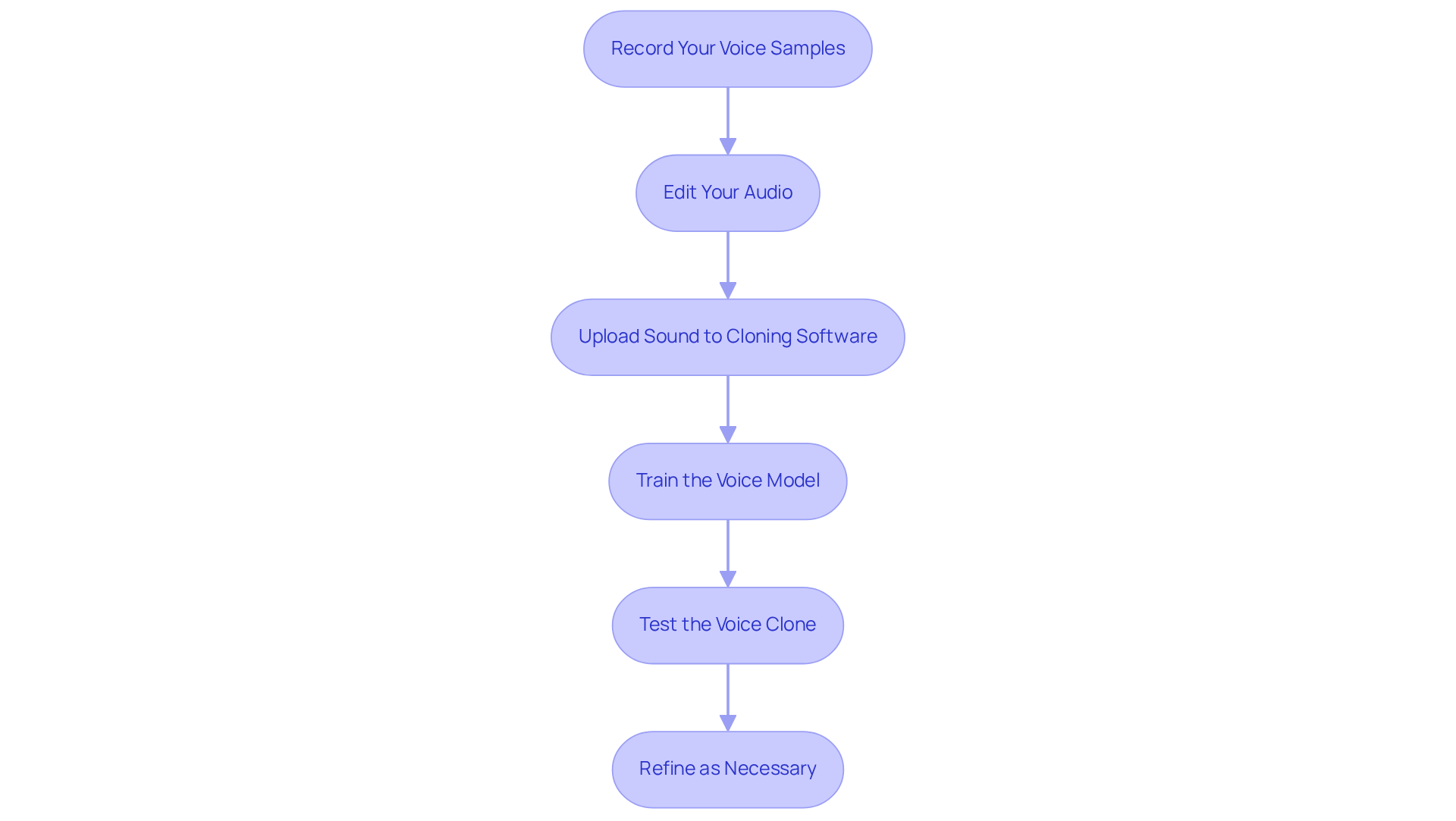
To effectively execute the , follow these detailed steps:
- Record Your Voice Samples: Start by utilizing a to capture at least 30 minutes of clear sound. Speak naturally, incorporating a range of emotions and tones to enrich your dataset. You can as many times as needed before submission to ensure top-notch quality.
- Edit Your Audio: Clean your recordings by removing background noise and ensuring consistent volume levels. Save the final sound files in a compatible format, such as WAV or MP3, to facilitate smooth processing. For optimal sound quality, it’s suggested to test your microphone at a sample rate of 22050 Hz.
- Upload Sound to Cloning Software: Open your chosen cloning tool and upload your edited sound files. Adhere to the software's guidelines for data input to ensure proper functionality.
- : Initiate the training process within the software. This step can take several days, depending on the length of your audio and the complexity of the model being used. Expect to generate five audio samples every few hundred steps during training, with at least 100 samples suggested for optimal results. Notably, the is commonly used for training.
- Test the : After training, generate speech by inputting text into the model. Evaluate the output to assess the quality and authenticity of the . Utilize Signal to Noise Ratio (SNR) diagnostics to ensure your recordings are of high quality; a value below 15 indicates poor quality.
- Refine as Necessary: If the produced output does not meet your expectations, consider retraining the model with additional or varied sound samples to enhance accuracy and realism. Remember to create copies of your dataset before applying any audio processing filters to avoid losing the original files.
By following these steps, you can effectively understand how to clone voices tailored to your , enhancing your outreach and engagement strategies. As an AI audio replication expert aptly stated, "The is essential for attaining a persuasive vocal duplicate.
Troubleshoot Common Voice Cloning Issues
Even with careful preparation, issues may arise during the sound cloning process. Understanding these challenges is crucial for achieving . Here are some common problems and their solutions:
- : If the cloned sound appears robotic or unclear, it’s essential to ensure that your original recordings are of high quality. Re-record in a quieter environment if necessary to enhance clarity.
- : Should the voice clone sound different at times, check for variations in your original recordings. Consistency in tone and emotion is key to a successful clone.
- : If the cloning software fails to process your sound, verify that your files are in the correct format and that you have followed all upload instructions meticulously.
- : If the training process takes too long, consider using shorter audio samples or a more powerful computer to expedite the process.
- Feedback and Adjustments: After testing the audio clone, gather . Utilize this feedback to make necessary adjustments to your recordings or the training process.
By being aware of these common issues and their solutions, you can learn how to clone voices more effectively and achieve better results.

Conclusion
Mastering the art of voice cloning is not just an opportunity; it’s a game-changer for sales managers looking to elevate customer engagement and streamline communication. By grasping the fundamentals of AI voice cloning - such as voice models, training data, and synthesis processes - professionals can craft authentic vocal replicas that truly resonate with clients. In today’s competitive landscape, this innovative technology has become a necessity, making it accessible for businesses of all sizes.
The article outlined essential steps for effective voice cloning, emphasizing the preparation of high-quality audio samples and troubleshooting common issues that may arise during the process. Key points included:
- The critical importance of using quality recording equipment
- Selecting appropriate software
- Ensuring a conducive recording environment
Furthermore, understanding how to refine the cloned voice based on feedback can significantly enhance the effectiveness of sales strategies.
As the market for AI voice cloning continues to expand, embracing this technology can lead to improved sales outcomes and heightened customer satisfaction. Sales managers are strongly encouraged to explore the tools and techniques discussed, ensuring they remain at the forefront of an ever-evolving digital landscape. By leveraging voice cloning, organizations can foster more personalized interactions, ultimately driving engagement and conversion rates to unprecedented heights.
Frequently Asked Questions
What is AI voice cloning?
AI voice cloning is a technology that uses machine learning algorithms to create a digital replica of an individual's unique tone by training models on recorded speech data, capturing vocal traits like tone, pitch, and cadence.
What is a voice model?
A voice model is a digital representation of a voice created from audio samples that allows for the synthesis of speech that sounds remarkably authentic.
What is training data in the context of AI voice cloning?
Training data refers to the collection of audio recordings used to train the vocal model, ensuring it accurately reflects the nuances of the original sound.
What does synthesis mean in AI voice cloning?
Synthesis is the process of generating speech from the sound model, enabling personalized and engaging customer interactions.
What is the projected market value for AI speech replication by 2026?
The market for AI speech replication is projected to reach USD 3.4 billion by 2026.
How accessible is AI voice cloning technology for businesses?
AI voice cloning technology is becoming increasingly accessible for businesses of all sizes, as it no longer requires a multi-million dollar budget to implement.
How can sales managers benefit from understanding AI voice cloning?
By mastering voice cloning concepts and exploring successful applications, sales managers can enhance their sales processes and improve customer engagement.
What features does Intone's AI agents offer?
Intone's AI agents provide seamless deployment and customization, real-time monitoring, high-volume dialing, and smart analytics to help sales teams track performance and refine their strategies.
How does Intone help in boosting sales conversion rates?
Intone empowers sales managers by enhancing operational efficiency and customer engagement, which can lead to elevated conversion rates.
List of Sources
- Understand AI Voice Cloning Basics
- 35 AI Quotes to Inspire You (https://salesforce.com/artificial-intelligence/ai-quotes)
- blogs.oracle.com (https://blogs.oracle.com/cx/10-quotes-about-artificial-intelligence-from-the-experts)
- AI Quotes From Some Of The Worlds Top Minds | Alldus (https://alldus.com/blog/ai-quotes-from-some-of-the-worlds-top-minds)
- AI Voice Cloning Market Size & Share - America, Europe, & APAC Statistics 2026-2035 (https://fundamentalbusinessinsights.com/industry-report/ai-voice-cloning-market-4816)
- forbes.com (https://forbes.com/sites/robtoews/2020/03/28/12-thought-provoking-quotes-about-artificial-intelligence)
- Prepare for Voice Cloning: Tools and Requirements
- Voice Cloning Market Size, Share, Trends & Growth, 2033 (https://marketdataforecast.com/market-reports/voice-cloning-market)
- The ROI of Using AI Voice Cloning in Advertising Campaigns (https://respeecher.com/blog/ai-voice-advertising-roi)
- Top 3 AI Voice Cloning Platforms in 2026 - EnosTech.com (https://enostech.com/top-3-ai-voice-cloning-platforms-in-2026)
- Best AI Voice Cloning Tools in 2026: 8 Platforms Ranked by Use Case (https://fish.audio/blog/best-ai-voice-cloning-tools)
- Voice Cloning Market Size, Share, Trends & Insights Report, 2035 (https://rootsanalysis.com/voice-cloning-market)
- Execute the Voice Cloning Process: Step-by-Step Instructions
- Cloning Your Voice — A Comprehensive Guide (TTS) (https://rioharper.medium.com/cloning-your-voice-a-comprehensive-guide-tts-cb321908b060)
- How to clone a voice: beginner's guide to AI voice cloning | Amplemarket (https://amplemarket.com/blog/how-to-clone-a-voice-beginners-guide-to-ai-voice-cloning)
- The Ethics of AI Voice Cloning: A Comprehensive Guide (https://contentpod.co/blog/the-ethics-of-ai-voice-cloning-a-comprehensive-gui)