
Introduction
In today's fiercely competitive marketplace, the efficiency of sales processes can truly make or break a business. Embracing automation isn't just a trend; it's a strategic move that can lead to significant improvements in lead management, customer interactions, and overall sales performance. Yet, the real challenge lies in effectively integrating these technologies to maximize their impact.
What are the best strategies for automating sales processes? How can businesses leverage AI and real-time analytics to drive better results? These questions are crucial for any organization looking to enhance its sales capabilities. By exploring these strategies, companies can not only streamline their operations but also gain a competitive edge in their respective markets.
Integrate AI Voice Agents to Streamline Sales Processes
Incorporating AI voice assistants into your business processes can significantly optimize operations and enhance client interactions. These representatives excel at automating lead qualification, managing payment reminders, and delivering sales pitches. This allows human representatives to concentrate on more complex tasks. For instance, businesses utilizing Intone's AI voice assistants have reported a remarkable decrease of up to 70% in the time spent on initial client interactions. This leads to faster lead response times and considerably higher conversion rates.
To effectively implement this technology, businesses should follow these essential steps:
- Identify critical areas where voice agents can automate repetitive tasks.
- Select a customizable AI platform that aligns with specific operational needs.
- Train the AI on company-specific data to enhance its performance, enabling it to interact with clients in a natural and conversational manner.
However, it is crucial to avoid common pitfalls, such as inadequate training or failure to integrate the AI with existing systems, to maximize the benefits of this technology. This strategic approach not only streamlines sales processes but also enhances overall customer satisfaction. As David, Founder at GCS, remarked, "The AI consistently surpasses our human agents - 1.5× more conversions with less overhead." This underscores the effectiveness of the company's solutions in practical applications.

Utilize Real-Time Analytics for Informed Decision-Making
Real-time analytics is revolutionizing the way marketing teams enhance their decision-making capabilities. With AI sales representatives from the company, businesses can seamlessly implement and customize their solutions, gaining immediate insights into customer behavior, market trends, and campaign effectiveness. By analyzing live data through advanced analytics tools, sales experts can monitor key performance indicators (KPIs) in real-time, leading to a reported 15-20% improvement in performance for businesses that adopt these strategies.
To effectively harness this potential, businesses should leverage Intone's analytics dashboards and reporting features. These tools empower teams to pivot strategies swiftly, ensuring they remain competitive and responsive to market changes. Don't miss out on the opportunity to elevate your marketing efforts - embrace real-time analytics today.

Customize Sales Campaigns with AI for Targeted Engagement
Tailoring promotional campaigns with AI dramatically enhances client engagement and conversion rates. By leveraging AI algorithms to analyze client data, businesses uncover patterns and preferences that inform targeted marketing messages tailored to specific segments. For instance, finance companies focusing on high-intent leads have reported conversion rate increases of up to 25%.
AI voice systems exemplify this capability, overseeing calls, assessing performance, and enhancing sales in real-time. This has resulted in a 1.5x rise in conversion rates compared to human representatives. Phil Portman, Founder & CEO of Textdrip, notes, "Customers love personalization until it crosses into the territory of 'How did they know that?'" This underscores the importance of balancing personalization with customer comfort.
To effectively implement this strategy, businesses should adopt AI-driven marketing platforms that can automate the segmentation and personalization of campaigns. Running A/B tests can refine approaches, ensuring outreach resonates with the intended audience. Regularly testing and optimizing these campaigns based on performance metrics will further enhance their effectiveness. Companies like GCS have reported that Intone’s AI consistently outperforms human agents, achieving 1.5x more conversions with less overhead.
However, companies must be aware of common pitfalls, such as over-segmentation or misinterpreting data, which can lead to ineffective campaigns. Incorporating real-world examples, such as a finance company that successfully increased engagement through targeted AI strategies, illustrates the potential of AI in enhancing sales outcomes.

Implement Automated Follow-Ups to Maintain Customer Engagement
Implementing automated follow-ups is crucial for maintaining client engagement and ensuring effective nurturing of leads. With AI voice agents, businesses can enhance their campaigns, leading to improved interactions with clients. Automated systems can send personalized messages to prospects after initial contact, reminding them of offers or providing additional information. In fact, research indicates that timely follow-ups can boost conversion rates by as much as 50%.
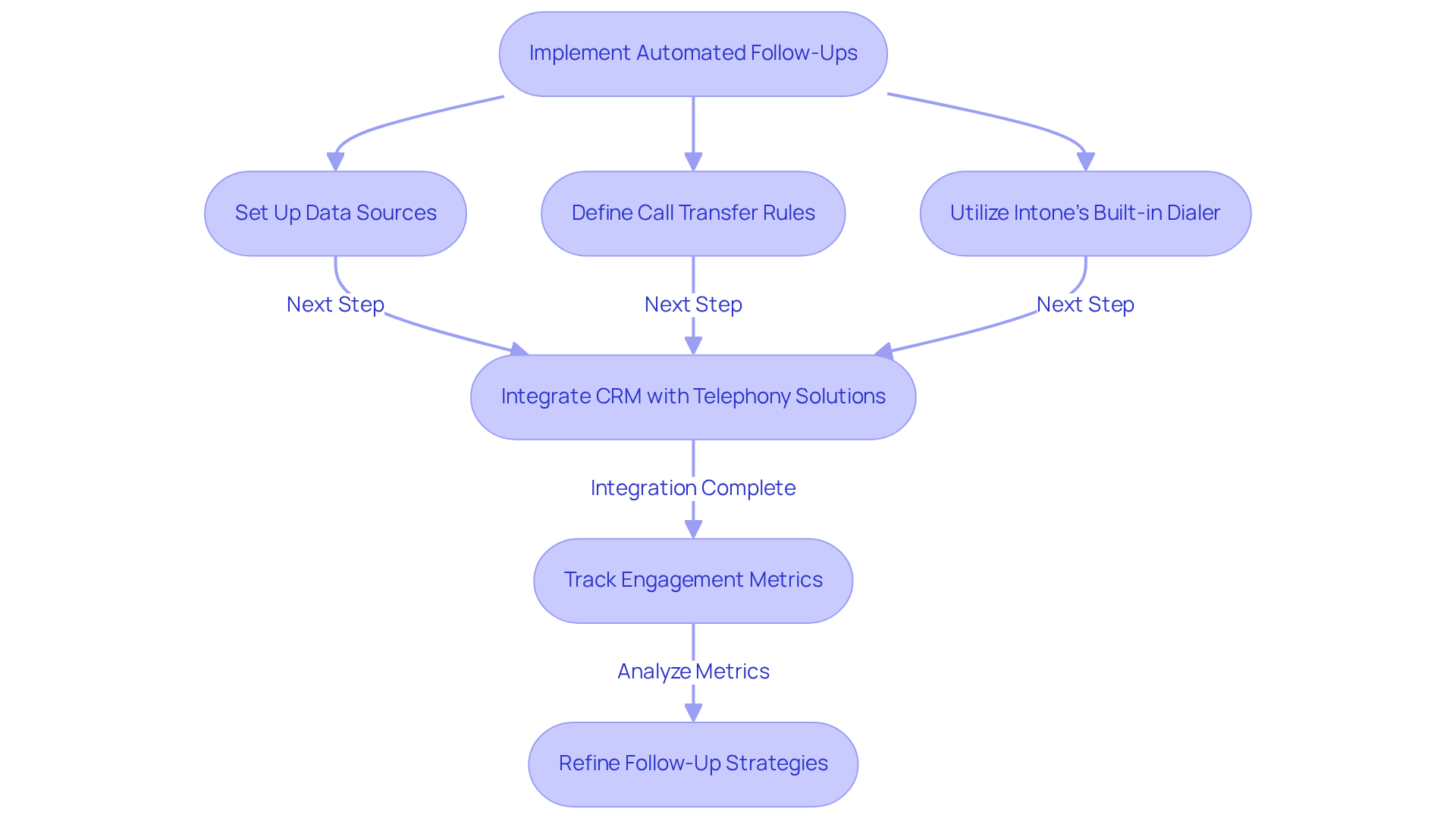
To establish an efficient system that can auto automate follow-ups, businesses should integrate their CRM with telephony solutions that facilitate smooth call transfers and real-time analytics. This integration allows for tracking engagement metrics, which helps refine follow-up strategies, ensuring they remain relevant and effective.
Consider these steps for customization:
- Set up data sources to gather customer information.
- Define call transfer rules to ensure seamless communication.
- Utilize Intone's built-in dialer for efficient call management.
By following these steps, businesses can effortlessly auto automate the deployment of AI agents tailored to their specific needs, driving engagement and enhancing overall performance.
Conclusion
Integrating automation into the sales process is not just beneficial; it’s essential for businesses that want to enhance efficiency and drive better results. By leveraging AI voice agents, real-time analytics, and automated follow-ups, organizations can streamline operations, personalize customer interactions, and ultimately boost conversion rates. This thoughtful implementation of technology not only saves time but also elevates the overall customer experience.
Key insights reveal the transformative power of AI in sales. Utilizing voice agents to handle repetitive tasks and enhance lead qualification, alongside employing real-time analytics for informed decision-making and personalized marketing campaigns, significantly contributes to improved sales outcomes. Moreover, the importance of automated follow-ups cannot be overstated; timely engagement can lead to substantial increases in conversion rates.
These strategies extend beyond immediate sales results; they signify a shift towards a more data-driven, customer-centric approach in business. Embracing automation and AI technology is not merely a trend but a necessary evolution for companies aiming to remain competitive in the marketplace. By adopting these best practices, organizations can enhance their sales processes and foster lasting relationships with their customers, ensuring sustained success in the future.
Frequently Asked Questions
How can AI voice agents optimize sales processes?
AI voice agents can automate lead qualification, manage payment reminders, and deliver sales pitches, allowing human representatives to focus on more complex tasks.
What results have businesses seen from using AI voice assistants?
Businesses using AI voice assistants, such as Intone's, have reported a decrease of up to 70% in the time spent on initial client interactions, leading to faster lead response times and higher conversion rates.
What are the essential steps to implement AI voice agents in a business?
The essential steps include identifying critical areas for automation, selecting a customizable AI platform that meets operational needs, and training the AI on company-specific data for better client interaction.
What common pitfalls should businesses avoid when integrating AI voice agents?
Businesses should avoid inadequate training of the AI and failure to integrate it with existing systems to maximize the benefits of the technology.
How does the performance of AI voice agents compare to human agents?
According to David, Founder at GCS, AI voice agents can achieve 1.5 times more conversions than human agents while requiring less overhead, demonstrating their effectiveness in practical applications.